Introduction
On September 21, 2026 the federal government introduced Bill C-39, the Building Canada Strong Act. The Bill is meant to deliver on Canada’s plan to significantly transform how decisions are made about projects the federal government regulates.
It comes only a few years after the Impact Assessment Act came into force in 2019 to modernize federal project review, with decisions that better account for impacts on Indigenous rights, climate change and species at risk. The Act was then significantly narrowed in 2024, after Alberta’s challenge to its scope led the Supreme Court of Canada to find parts of it unconstitutional.
Bill C-39 proposes significant changes to impact assessment processes and timelines and will have practical impacts on how Indigenous governments advocate for their rights and interests.
It proposes to hand much of the Impact Assessment Agency’s functions to other regulators, including the Canadian Nuclear Safety Commission for nuclear projects. This significantly expands recent changes from earlier this month that gave the Canada Energy Regulator sole assessment authority for pipelines and power lines.
Together, the changes proposed in Bill C-39 will reshape how Ottawa makes decisions about resource development, and how Indigenous governments are consulted and engaged on those decisions:
- The government’s proposal. Canada describes the Bill as “a change in federal process, not standards.” That process is focused around the concepts of one project, one consultation, one year.
- What Indigenous governments will need to grapple with. Consultation will be compressed into fewer, earlier stages, with fewer chances to raise concerns later at the permit stage. Nations may be dealing with different regulators than before, on tighter timelines. Consultation strategies, capacity funding requests and in-house studies will all need to adapt.
The Bill may still change as it moves through Parliament, and this post should be treated as a first pass over the key aspects of the Bill under consideration. Nations should consider opportunities to raise concerns during house and senate committees as this Bill advances.
What role will the Impact Assessment Agency still have?
Bill C-39 (“Bill”) involves a host of changes to the Impact Assessment Act (“IAA”). Under the Bill, the Impact Assessment Agency of Canada (“IAAC”) will assess fewer kinds of projects but will become the single window for federal permits and consultation on the projects it keeps.
- Where things stand now. Today, IAAC leads federal impact assessments for most major projects. For pipelines and nuclear projects, it currently shares the work with the Canada Energy Regulator (“CER”) or Canadian Nuclear Safety Commission (“CNSC”) through joint review panels and other cooperative processes.
- Fewer projects. IAAC loses nuclear projects to the CNSC. Pipelines and power lines already moved to the CER by regulation in September 2026. IAAC keeps mines, dams, ports and other projects that engage a federal interest.
- A new “one window” role. For the projects it keeps, IAAC coordinates all federal permits and consultation. The Environment Minister issues one decision that covers the assessment and the main federal permits (IAA, 64.2, 65(1)). Departments, like the Department of Fisheries and Oceans, must share information and flag problems early (IAA, ss. 59.1–59.3).
- Who makes the big call. Each type of IAAC project gets a “designated minister” (IAA, s. 9(6.2)). That Minister and the Environment Minister can decide together that serious harm is justified without going to Cabinet (IAA, s. 60(2)(a)). In making this decision, they must consider:
- the potential impacts of the project’s likely effects on Indigenous groups and s. 35 rights;
- the extent to which the project’s likely effects contribute to Canada’s ability to meet its environmental obligations and climate commitments; and
- the extent to which the project’s likely effects contribute to sustainability.
- Regional assessments matter more. IAAC’s regional assessments become the first step for designating regions of national interest (see below). Nations should treat any regional assessment in their territory as high-stakes.
Which agency will handle nuclear projects?
The Canadian Nuclear Safety Commission becomes the lead assessor and decision-maker for nuclear projects, with no review panel and Cabinet as the backstop.
- Where things stand now. Today, nuclear projects on the federal project list are assessed by the IAAC, or by a joint IAAC–CNSC review panel if the Minister refers them to one. The CNSC then licenses the project separately. Smaller nuclear projects go through CNSC licensing only.
- The CNSC takes over. Under the Bill, the CNSC runs the impact assessment for nuclear projects from start to finish if those projects are designated under the IAA (IAA, s. 8.3(a)). Every nuclear project on the list gets a full assessment (IAA, s. 17.2), and review panels are no longer an option (IAA, s. 36.1).
- How decisions get made. The CNSC has 300 days to write its report once the proponent’s studies are complete (IAA, s. 28(2.1)). If the CNSC finds the project could cause serious (“significant”) harm, Cabinet decides within 65 days whether the harm is justified (IAA, ss. 61.1(1), 61.1(2)). The CNSC’s conditions become licence conditions it enforces itself (IAA, s. 67(1)).
- Why it matters for Nations. This is a significant shift in the work to be done by the CNSC and will require Nations to engage directly with the CNSC to raise concerns. Projects already underway may switch to the CNSC, and the CNSC can allow some early work before its decision (IAA, ss. 7(3)(e)).
What is changing for pipelines and power lines?
Ottawa has already moved interprovincial and international pipelines and power lines out of the Impact Assessment Act by regulation, before Bill C-39 was introduced. These projects will now be reviewed by the Canada Energy Regulator alone.
- Where things stand now. On September 3, 2026, Cabinet exempted interprovincial and international pipelines, international and interprovincial power lines, and CER-regulated offshore renewables from impact assessment and CER review by amending the Physical Activities Regulations. Before this, large pipelines and power lines (75 km or more of new right of way) needed a joint IAAC–CER review panel.
- What a CER review looks like. The CER must consider much the same factors as an impact assessment, including effects on s. 35 rights and Indigenous interests and concerns.
- How Bill C-39 builds on it. The Bill stops the Minister from pulling CER-regulated projects back into the IAA and makes the CER the sole assessor for pipelines, designated powerlines, and offshore renewable energy projects (IAA, s. 9(7)(c), CERA, 75.1). The Bill also creates a two-track pipeline certificate regime. It shortens CER timelines (450 to 300 days for pipeline certificates; 300 to 180 days for smaller applications), and the Minister can extend by only 90 days, and only to fulfil the duty to consult (CERA, ss. 183(4)-(6), 186(4)-(6)).
- What Indigenous groups raised. During its engagement with Indigenous peoples, Canada noted concerns about loss of independent review panels, fairness and impartiality, consistency with UNDRIP, and effects on co-management regimes such as in the Mackenzie Valley.
- Why it matters for Nations. For any pipeline or transmission line in your territory, the CER is now the main venue. Nations should seek intervenor status and CER participant funding early, and push for a consultation agreement covering Crown consultation.
How will Crown consultation be coordinated?
The Bill coordinates who runs consultation and folds key federal permits into the impact assessment, but it does not change the legal content of the duty to consult.
- Where things stand now. Today, consultation on a major project often happens in rounds: first during the impact assessment, then again when departments like Fisheries and Oceans Canada issue permits afterward. Each round can involve different officials and different funding.
- One process per project, per community. The Bill makes coordinating Indigenous consultation part of the IAA’s purpose (IAA, s. 6(1.1)(b)). IAAC coordinates from the first project filing until construction is finished (IAA, 155(b.1)). The CNSC and the CER play the same role for their projects (IAA, s. 165.1(b); CERA, s. 75.1).
- Permits get decided together. Key federal permits (fisheries, navigable waters, disposal at sea, species at risk) are now decided with the impact assessment, in one decision (IAA, s. 64.2, Schedule 5). That means Nations must raise concerns during the impact assessment process and not wait until later processes that are now eliminated.
- What doesn’t change. The Crown’s legal duty to consult stays the same, and courts can still review whether it was met. Funding for consultation on the bundled permits is optional, not guaranteed (IAA, 75.1). Practical considerations include whether to enter into a consultation agreement early on, how to secure capacity funding, and developing a workplan built for your Nation.
What does the “one-year” timeline actually cover?
The one year runs from the notice that the proponent’s studies are complete, not from project filing, and it is a target that can be extended or suspended.
- Where things stand now. Today, the IAA already sets time limits for each phase, but the clock stops while the proponent prepares its studies. In practice, federal reviews of major projects often take several years from start to finish.
- The year starts late. The one-year promise starts only once the proponent’s studies are complete (IAA, ss. 19(4), 65(10)). It covers 300 days for the review and 65 days for the decision (IAA, 28(2.1), 37(2), 65(3)).
- Time before the clock starts. First comes a 180-day planning phase, which can be extended or paused (IAA, ss. 18(1), 18(3), 18(5)). Then the proponent has 365 days to do its studies, and can get more time on request, with no limit (IAA, ss. 19(1)-(2)). From first filing to decision, most projects will still take well over a year.
- One year is a target, not a deadline. Ministers can grant the IAAC 90-day extensions to conduct the assessment, which Cabinet can extend indefinitely, and time limits can be paused under regulations (IAA, ss. 28(6)–(9)). If the Minister fails to make a decision within the one-year target, they simply post their reasons for this online along with a new timeline (IAA, s. 65(10)). As mentioned above, CER reviews also get accelerated.
- Why it matters for Nations. Your own studies, including Indigenous knowledge and rights studies, need to happen early, before the clock starts. Once it starts, there is little room to add new evidence. This diagram shows the timeline:

Only the last two boxes count toward the one-year commitment.
How will impacts on Indigenous rights be assessed?
The legal tests for rights impacts are unchanged in substance, but who decides, when, and on what record all shift.
- Where things stand now. Today, federal impact assessments must look at effects on Indigenous peoples and their s. 35 rights. Where serious harm is found, the Minister or Cabinet decides whether it is justified in the public interest, and impacts on rights are one of the factors they must weigh.
- The rules on rights stay. Impacts on rights must still be assessed, and proponents must still explain how they will address them (IAA, 22(1), 15(1)). Reports must show how Indigenous knowledge was used, and decisions must give reasons that address impacts on rights (IAA, ss. 28(3.1), 63(a), 65(2)).
- However, assessment involves fewer decision-makers and less time. As explained above, two ministers can now decide that serious harm is justified, without input from Cabinet. The rights evidence has to fit inside the 300-day assessment. Because permits are now decided at the same time, there is less chance to deal with detailed rights impacts later.
- Work can start before the decision. Ministers or the CNSC can allow some early work before a project is approved if they think it’s in the public interest (IAA, 7(3)(d)–(e)). This means rights could be affected before consultation is finished. Nations should watch for this and be ready to push back.
Does the Bill address UNDRIP and free, prior and informed consent?
No. The Bill does not mention the UN Declaration on the Rights of Indigenous Peoples (“UNDRIP”), the United Nations Declaration on the Rights of Indigenous Peoples Act (“UNDA”), or free, prior and informed consent (“FPIC”).
- Where things stand now. Under UNDA, Canada must take all measures necessary, in consultation and cooperation with Indigenous peoples, to make federal laws consistent with UNDRIP ( 5). Article 32(2) of UNDRIP calls for governments to obtain FPIC before approving projects affecting Indigenous lands and resources. The current IAA already states that Canada is committed to implementing UNDRIP.
- What the Bill does and doesn’t do. The Bill leaves the existing IAA preamble in place but adds nothing that gives effect to UNDRIP or FPIC. The new timelines, early-works powers, bundled permit decisions and deemed approvals in regions of national interest are all designed around speed and certainty for proponents. None of them build in a consent-based process or a decision-making role for Indigenous governments. From a practical perspective, Nations seeking consent processes will face pressure to undertake those processes in the face of highly constrained timelines.
- What Indigenous participants told Canada. Some Indigenous peoples who participated in the engagement process supported a single consultation process, but they noted that timelines must still respect rights and support meaningful consultation and FPIC.
- Tools that already exist. The IAA already allows cooperation with, and delegation of parts of an assessment to, Indigenous governing bodies and some time limits can be extended at a jurisdiction’s request (IAA, s. 18(3)). Nations can use these to press for Nation-led or co-led assessments that operate on consent-based principles.
- What Nations can ask for. Parliament could add a clause requiring the Act to be applied consistently with UNDA, along with a clause building in more time for consent-based pathway for Nations that want one. Nations can raise s. 5 of UNDA in committee submissions, and in consultation on the regulations still to come.
Will project approvals change under the Building Canada Act?
Bill C-39 is also changing the Building Canada Act, which passed in 2025 (“BCA”). Notably, it will establish “regions of national interest.” Regions of national interest move the key fight from each project to a regional assessment: once a region is designated, eligible projects get pre-approved findings and a single deemed permit document.
- Where things stand now. Today, the BCA lets Cabinet name individual “national interest projects” for a faster approval track. But there is no way to designate a whole region, and regional assessments under the IAA don’t approve anything on their own.
- How a region gets designated. Under the Bill, Cabinet can define a region, setting out its boundaries, which kinds of projects qualify, and the criteria they must meet (BCA, s. 8.2(1)). A regional assessment must be done first, and Cabinet must consider any report that comes from that process (BCA, s. 8.2(5)).
- What regions have been designated. Canada has not yet announced what areas will be designated as regions of national interest. However, the Bill lays out factors that Cabinet may consider. These are:
- strengthening Canada’s autonomy, resilience, and security;
- providing economic or other benefits to Canada;
- having a high likelihood of successful execution;
- advancing the interests of Indigenous peoples; and
- contributing to clean growth and to meeting Canada’s objectives with respect to climate change (BCA, s. 8.2(6)).
- Consultation happens twice. Before a region is named, the Minister must be satisfied that Indigenous peoples whose rights could be affected were adequately consulted (BCA, s. 8.2(7)). Nations must be consulted again before each project’s approval document is issued, and before its conditions change (BCA, ss. 8.4(2)(d), 8.5(3)(b)).
- What designation does for a project. If a project fits the region’s criteria, the findings needed for its federal permits are treated as already made in its favour (BCA, s. 8.3). The Minister is then required to issue an approval document that counts as all the project’s permits (BCA, s. 8.4). If the project has also been designated under the IAA, the assessment can’t revisit any effects the regional assessment already covered (BCA, s. 19(2)).
- Why it matters for Nations. Since the IAA was introduced in 2019, many Nations have requested regional assessment so that cumulative effects of regional development can be meaningfully considered before piecemeal approvals are granted. However, only a small handful of regional assessments have been completed over 7 years. Under the Bill, regional assessments, if they do take place, become a critical way for Nations to seek a lead or co-lead role, get their rights evidence into the regional record, and push for criteria that reflect their conditions.
What changes for fisheries and species at risk permits?
The Bill adds changes that could have a significant impact on how federal decision-makers handle harm to fish, fish habitat, and species at risk. In particular, the Bill proposes to add a feasibility test for permit conditions, open the door to paying fees to offset harm to fish habitat, and move key Fisheries Act rule-making from Cabinet to the Minister of Department of Fisheries and Oceans.
- Where things stand now. Today, the Department of Fisheries and Oceans issues Fisheries Act authorizations for projects that harm fish or fish habitat, and species at risk permits come from the responsible minister. Permit conditions are set to protect fish and species, and offsetting harm is mostly done by the proponent itself.
- Conditions must be “feasible.” The Bill proposes limits on the Crown in setting permit conditions. Before setting a condition, the relevant Ministers must consider whether they are technically, economically and practically feasible (Fisheries Act, s. 35.01; SARA, s. 73.1). This applies even when the permits are decided inside of an impact assessment. In other words, costs for proponents could weaken conditions that protect fish and species at risk.
- Paying to offset harm. New regulations could also let proponents pay a fee instead of fixing harm to fish habitat themselves (Fisheries Act, s. 43.31(1)(b), (h)). The money goes into a general federal fund (s. 16.1), with no rule that it be spent in the affected watershed or territory. These regulations are not part of the present Bill but Nations should watch for their development.
- Habitat banking opens up. Currently, organizations involved in restoring fish habitat may earn “credits” for their work to offset impacts on fish habitat. The Bill creates a pathway for the Minister to create a system for organizations to sell those credits to project proponents (Fisheries Act, s. 42.01(1)(a)). Credits can only be used in the service area where the habitat bank is located (Fisheries Act, s. 42.03). This could be an opportunity for Nation-led habitat banks, but also a risk if service areas are drawn very large. This may also lead to promised mitigation that does not work in practice or that does not address Indigenous specific concerns.
Can work start before a project is approved?
The Bill may let the Minister—or the CNSC for nuclear projects—allow parts of a project to start before the project is approved if they think this would be in the public interest.
- Where things stand now. Today, the IAA generally bars a proponent from starting work that could cause certain effects, including effects to Indigenous peoples, until the project is approved (IAA, s. 7(1)).
- What the Bill allows. For IAAC projects, the Minister will be able to issue an order allowing specified activities to take place before the decision if the Minister considers it in the public interest (IAA, s. 7(3)(d)). For nuclear projects, the CNSC can do the same (IAA, 7(3)(e)). Federal departments can then issue permits and funding for that early work (IAA, ss. 8(d), 8.2(c), 64.1).
- The limits. Early works can never cover the whole project (IAA, s. 7(7)) and the Minister or CNSC must set conditions requiring the proponent to fix any harm the early work causes (IAA, s. 7(6)).
- No express consultation step. The Bill does not say Nations must be consulted before early works are allowed. But because early works can affect rights, the Crown’s duty to consult still applies before the order is made. Nations should ask for notice of any early-works request, a chance to respond, and reasons.
- Why it matters for Nations. Early works can create facts on the ground before the rights assessment is finished, and make a later “no” harder. Clearing, access roads and site preparation are the kinds of work to watch. This is likely to be one of the most contested parts of the Bill, in negotiations and in court.
Will projects already under review be affected?
Whether a project already in the federal process moves to the new rules depends on how far along it is on the day the changes come into force.
- Where things stand now. Today, projects already in the federal process are being reviewed under the current IAA and CERA. Nothing changes until Cabinet brings the new rules into force by order, on a date not yet set (Bill C-39, cls. 93 and 158).
- IAAC projects. Projects where IAAC has already started the assessment—meaning where a notice of commencement has been posted, or a substitution has been approved—will stay under the current rules (IAA, s. 189). Projects that already have a decision stay under the current rules, too (IAA, s. 190). However, projects still in the planning phase appear to move to the new rules.
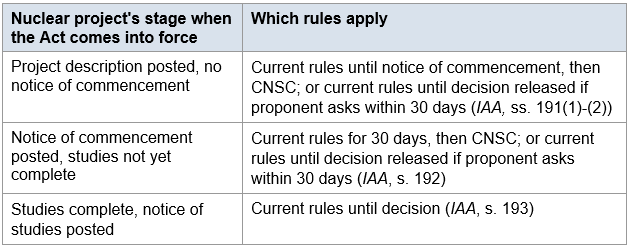
- Nuclear projects. Pending nuclear projects shift to the CNSC depending on their stage, as set out in the table below (IAA, ss. 191–193). In two of the three situations, the proponent can choose to stay with IAAC if it asks within 30 days.
- Pipelines and power lines. CER applications that have already found to be complete stay under the current CERA framework, including timelines (Bill C-39, cl. 155). New applications get the shorter timelines.
- Why it matters for Nations. Nations should list every project in their territory that is in a federal process now and map which rules it will fall under. For nuclear projects, watch for a proponent’s election to stay or switch.
One last change: where court challenges get heard
The Bill also moves judicial review of certain Cabinet orders up a level. Challenges to orders naming a national interest project, or designating a region of national interest, would go directly to the Federal Court of Appeal instead of starting in the Federal Court (Federal Courts Act, s. 28(1)(a)).
Applications already filed in the Federal Court when the change takes effect will be transferred up, and any interim orders already made will be treated as orders of the Court of Appeal (Bill C-39, cl. 115). A parallel change applies to certain Cabinet orders under the CERA (Federal Courts Act, s. 28(1)(g)).
In practice this removes a rung from the ladder. A challenge is heard once, by a three-judge panel, with any further appeal only to the Supreme Court of Canada and only with permission. That may mean faster access to appellate courts, but it also means fewer chances to correct a result, and no ability to build a robust record of the evidence at the trial level.
For Nations this means that the evidence to support opposition to these designations must be prepared and submitted during the short consultations taking place relating to these designations. It will be very difficult to bring new evidence to the court for these challenges where it did not form part of the consultation record leading to these designations.
Conclusion
At the time of publication, the Bill is still being debated, with the first reading completed yesterday, September 21, 2026. The final contours of the Bill may change, but as proposed these changes will reshape decision making and put pressure on Nations to participate in new engagements and consultations processes with yet to be defined timelines and processes.
Key abbreviations
• Bill = Bill C-39, An Act respecting certain measures to strengthen the economy, 1st Sess, 45th Parl, 2026 (first reading)
• IAA = Impact Assessment Act, SC 2019, c 28, s 1
• IAAC = Impact Assessment Agency of Canada
• CERA = Canadian Energy Regulator Act, SC 2019, c 28, s 10
• CER = Canada Energy Regulator
• CNSC = Canadian Nuclear Safety Commission
• BCA = Building Canada Act, SC 2025, c 2, s 4[