On July 2, 2026, the federal government, British Columbia and Alberta made a series of coordinated announcements intended to advance a new oil pipeline from Alberta to British Columbia’s south coast. Together, the announcements, including the Canada–British Columbia Cooperative Prosperity Agreement and Alberta’s submission of the proposed West Coast Oil Pipeline Project to the federal Major Projects Office, represent one of the most significant developments in Canadian energy infrastructure policy since the completion of the Trans Mountain Expansion Project.
The announcements consist of two key components:
- Canada-British Columbia Cooperative Prosperity Agreement: Canada and British Columbia entered into the Canada-British Columbia Prosperity Agreement, under which British Columbia agreed to participate in the routing and permitting of a new interprovincial pipeline, while Canada committed to maintaining the North Coast tanker ban, supporting Indigenous equity participation, establishing an environmental liability framework and undertaking consultation with First Nations. Second, Alberta formally submitted its proposed West Coast.
- West Coast Oil Pipeline Project Submission: Alberta formally submitted its proposed West Coast Oil Pipeline Project to the federal Major Projects Office as a proposed Project of National Interest under the Building Canada Act. The proposal contemplates a new pipeline running from Bruderheim, Alberta to Roberts Bank in Delta, British Columbia, generally following the existing Trans Mountain corridor.
Much of the public discussion has focused on the political significance of these announcements and what they mean for Canada’s energy sector. However, there are significant legal and practical issues raised for Indigenous communities. Alberta’s proposal would cross the traditional territories of approximately 90 to 125 Indigenous communities, and both Canada and Alberta have placed emphasis on Indigenous equity participation and economic partnership as part of the project’s development.
These commitments warrant careful scrutiny. Opportunities for equity ownership and economic participation do not alter the Crown’s constitutional obligations. The duty to consult remains a distinct legal obligation that cannot be satisfied through economic participation. Similarly, many of the assumptions underlying Alberta’s proposal, including the final route, mitigation measures, environmental impacts and climate rationale, remain preliminary.
This blog post summarizes the two announcements and highlights several legal and practical issues that are likely to shape the next phase of the proposed West Coast Oil Pipeline Project.
BACKGROUND
Yesterday’s announcements consisted of two closely connected developments: one intergovernmental agreement and one project submission.
First, the federal government and British Columbia entered into a Canada-British Columbia Cooperative Prosperity Agreement, a broad agreement respecting major infrastructure, trade and resource development. The agreement addresses several priorities, including critical minerals, liquefied natural gas, electricity transmission, transportation infrastructure and port development. It also establishes a political framework for a new interprovincial pipeline between Alberta and British Columbia.[1]
Second, Alberta formally submitted its proposed West Coast Oil Pipeline Project to the federal Major Projects Office for consideration as a Project of National Interest under the Building Canada Act.[2] The proposal contemplates a new interprovincial pipeline capable of transporting approximately one million barrels of heavy crude oil per day from Bruderheim, Alberta to a marine export terminal at Roberts Bank in Delta, British Columbia.[3] The pipeline has two potential routes that have been identified, with only small variation between them (see Figure 1 for the “original corridor” and “optimized corridor” routes). The project would be advanced through a partnership involving the Alberta Petroleum Marketing Commission, Trans Mountain Corporation and Pembina Pipeline Corporation, with Trans Mountain leading project development, construction and operations.[4]
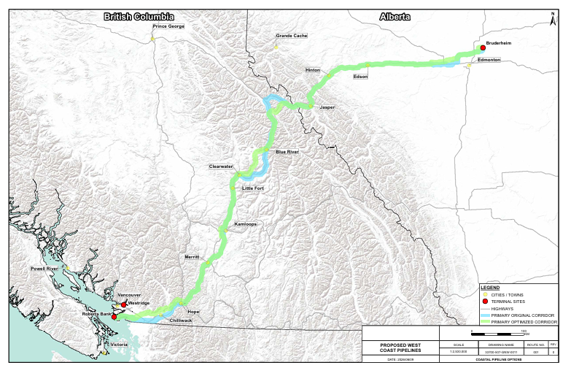
Figure 1: Proposed pipeline route, including original corridor and optimized corridor.[5]
While the project remains at an early stage, Alberta estimates construction costs between $35.2 billion and $43.7 billion and proposes an accelerated timeline that could see early works begin as soon as 2027, subject to regulatory approvals.[6]
THE TWO ANNOUCEMENTS: WHAT THEY DO AND WHY THEY MATTER
Although announced on the same day, the two announcements operate at different levels. The Canada–British Columbia Cooperative Prosperity Agreement establishes the political and intergovernmental framework under which a new interprovincial pipeline could proceed. Alberta’s West Coast Oil Pipeline Project submission, by contrast, is the first detailed proposal for the project itself. Together, they outline not only the governments’ vision for a new west coast pipeline, but also the legal, regulatory and policy assumptions on which that vision depends.
For Indigenous communities, understanding the distinction between these two documents is important. The Prosperity Agreement describes the political commitments made between governments, while Alberta’s submission provides insight into how the project is expected to proceed, including its proposed route, Indigenous participation strategy, environmental rationale and consultation framework. It is also the document that raises many of the legal and practical questions likely to shape the project’s future.
- Canada-British Columbia Prosperity Agreement
The Canada-British Columbia Prosperity Agreement establishes the political and intergovernmental framework under which the project would proceed. In particular, British Columbia acknowledges Canada’s constitutional jurisdiction over interprovincial pipelines and commits to acting in good faith through provincial routing and permitting processes, rather than seek to prevent a federally approved pipeline through litigation. In exchange, Canada agreed to:
- maintain the federal North Coast tanker ban;
- undertake early, consistent and meaningful consultation with First Nations;
- support Indigenous equity participation through federal loan guarantees;
- negotiate an economic and revenue-sharing framework with British Columbia;
- establish an environmental liability and emergency response fund accessible by British Columbia and First Nations; and,
- work cooperatively with British Columbia on permitting and approvals.[7]
- West Coast Oil Pipeline Project Submission
Unlike the Canada-British Columbia Cooperative Prosperity Agreement, which establishes the political framework for the project, Alberta’s West Coast Oil Pipeline Project submission provides the first detailed description of the proposed pipeline itself. The submission sets out Alberta’s rationale for the project, its proposed route, anticipated environmental and economic benefits, Indigenous participation strategy and proposed development timeline.
The submission raises several legal and practical questions that are likely to become central as the project proceeds through consultation and regulatory review.
a) The Existing Corridor Does Not Eliminate Legal or Environmental Concerns
A central feature of Alberta’s proposal is that the pipeline would largely follow the existing Trans Mountain corridor. Alberta emphasizes that approximately 90% of the proposed route would utilize existing transportation or utility corridors, reducing the need for new rights-of-way and limiting additional land disturbance.[8]
From a project planning perspective, this approach has obvious advantages. Existing rights-of-way, engineering information and operational experience may reduce certain construction impacts and avoid many of the political challenges that accompanied earlier proposals for a northern route.
However, the submission itself demonstrates that this remains an exceptionally large infrastructure project. Alberta proposes constructing approximately 1,200 to 1,250 kilometres of new pipeline, together with approximately 11 pump stations, new storage terminals at both ends of the pipeline and a major marine export facility at Roberts Bank capable of accommodating very large crude carriers.[9] The project would also require approximately 500 megawatts of electrical capacity and expanded marine spill response infrastructure.[10]
Moreover, the project will pass through the traditional territories of approximately 90-125 Indigenous communities, cross approximately 9-11 First Nation reserves in British Columbia, and terminate within Tsawwassen First Nation Treaty settlement lands.[11]
Accordingly, while the use of an existing corridor may reduce certain impacts, it does not eliminate the constitutional issues that arise where Crown decisions may adversely affect Aboriginal or Treaty rights. Nor does it eliminate broader concerns regarding cumulative effects in territories that have already experienced decades of industrial development.
b) Consultation has Been Promised, But Much of the Detail Remains Outstanding
The submission recognizes that the project will require consultation with approximately 23 Indigenous communities in Alberta, and 85 Indigenous communities in British Columbia, and it identifies a range of priorities raised during preliminary engagement, including protection of land and marine ecosystems, water quality, fish and wildlife habitat, cultural resources, emergency preparedness, pipeline integrity and the impacts associated with large temporary workforces.[12] The submission also notes concerns identified through engagement with Alberta’s Premier’s Council on Missing and Murdered Indigenous Women and Girls and Two Spirit Plus People regarding the risks associated with transient workforces.[13]
However, the submission remains preliminary in many respects.
Final routing has not yet been determined. The precise list of affected Indigenous communities may change as the route selection progresses. Mitigation measures remain largely conceptual. And a great many environmental studies have yet to be completed. Throughout the submission, consultation is described as work that will occur as the project advances, rather than as a process that has already been substantially undertaken.[14]
c) Economic Participation is Not the Same as Constitutional Consultation
One of the most notable aspects of Alberta’s proposal is the emphasis placed on Indigenous economic participation.
The submission describes Indigenous participation as a foundational component of the project and proposes opportunities for equity ownership, employment, procurement, contracting and business development.[15]
These opportunities may be significant for many First Nations and reflect the broader evolution of major project development in Canada, where Indigenous ownership is increasingly viewed as an important component of economic reconciliation. However, it is important to distinguish economic participation from the Crown’s constitutional obligations.
The duty to consult and, where appropriate, accommodate arises where Crown conduct may adversely affect Aboriginal and Treaty rights. It exists independently of whether a Nation ultimately supports a project, opposes it, or chooses to become an equity partner. Opportunities for ownership, contracting or employment may form part of an accommodation package in some circumstances, but they do not replace the Crown’s duty to consult.
This distinction is likely to become increasingly important as governments continue to pair Indigenous equity participation with accelerated approvals for major projects.
d) The Project’s Climate Case Depends on the Proposed Pathways Project
The submission also places significant reliance on the proposed Pathways Project as part of its climate rationale.[16]
Alberta repeatedly links the proposed pipeline with the Pathways Project, suggesting that carbon capture and storage will enable continued growth in oil sands production while substantially reducing upstream greenhouse gas emissions.[17]
That assumption deserves careful scrutiny.
The Pathways Project remains a proposed project. Although it has been under development for several years, it has not completed Alberta’s regulatory approval process and remains subject to ongoing regulatory review, permitting requirements and commercial negotiations. Its timing, ultimate design, and effectiveness therefore remain uncertain. To the extent that Alberta’s environmental case for the pipeline depends upon the successful implementation of the Pathways Project, those assumptions should be understood as contingent, rather than established.
It is also important to distinguish what carbon capture is intended to achieve, and what it is not.
The Pathways Project proposes to capture a portion of greenhouse gas emissions generated during oil sands production and permanently store those emissions underground. It does not address the greenhouse gas emissions generated when the oil transported through the pipeline is ultimately refined and combusted by end users. Nor does it eliminate many of the broader environmental effects associated with expanded oil production, pipeline construction, increased tanker traffic or cumulative industrial development.
Indeed, Alberta’s submission estimates that increased oil production associated with the project could generate approximately 15.5 to 18.2 megatonnes of additional upstream greenhouse gas emissions annually between 2032 and 2041 before accounting for proposed mitigation measures.[18]
The submissions argue that these emissions may be offset, in part, through carbon capture technologies, lower transportation emissions relative to rail and the displacement of higher-emitting crude in international markets.[19] That reasoning is already the subject of a vigorous scientific, policy and regulatory debate.
For many Indigenous communities involved in consultation and regulatory processes, these issues likely warrant close attention. If the climate benefits of the proposed pipeline depend in significant part upon another major project that has yet to receive regulatory approval, there will likely be questions regarding how those assumptions have been incorporated into the project’s environmental assessment and the extent to which they can properly be relied upon in evaluating the pipeline’s overall environmental effects.
NEXT STEPS
The July 2 announcements are significant political developments, but they should not be mistaken for legal or regulatory approval of the proposed pipeline. Much of Alberta’s submission remains conceptual and many of the issues that will determine whether, and in what form, the project ultimately proceeds have yet to be addressed.
Perhaps the most immediate issue is consultation. Although Alberta’s submission repeatedly emphasizes its commitment to engaging with First Nations, it also makes clear that many of the project’s defining features remain unresolved. The final route has not been selected. Environmental studies have yet to be completed. Mitigation measures remain largely conceptual. The precise list of affected First Nations may change as routing decisions are made. In many respects, the submission contemplates consultation as a process that will occur in the future, rather than one that has already meaningfully informed the project’s design. For First Nations whose Aboriginal or Treaty rights may be affected, an important question will be whether consultation can genuinely shape project planning, or whether it will occur after key strategic decisions have effectively been made.
The July 2 announcements therefore mark the beginning, not the conclusion, of the legal and regulatory process. The project’s ultimate success will not depend solely on financing, engineering or political support. It will also depend on whether governments can demonstrate that the project has been planned, assessed and advanced in a manner that meaningfully addresses cumulative effects, withstands environmental scrutiny, and satisfies the Crown’s constitutional obligations to affected Indigenous communities.
————
[1] Prime Minister of Canada, Canada-British Columbia Prosperity Agreement, online: https://www.pm.gc.ca/en/news/backgrounders/2026/07/02/canada-british-columbia-cooperative-prosperity-agreement
[2] Alberta Government, West Coast Oil Pipeline Project: Plain Language Summary of the Submission by the Government of Alberta to the Major Projects Office for Listing Under the Building Canada Act, online: https://open.alberta.ca/dataset/a529e3da-6368-43d7-af43-74b1773be517/resource/c6269884-58fd-40fa-bb52-01d0c0360bc2/download/west-coast-oil-pipeline-project-submission-to-mpo-plain-language-summary.pdf at p. 4.
[3] Alberta Government, West Coast Oil Pipeline Project: Plain Language Summary of the Submission by the Government of Alberta to the Major Projects Office for Listing Under the Building Canada Act, online: https://open.alberta.ca/dataset/a529e3da-6368-43d7-af43-74b1773be517/resource/c6269884-58fd-40fa-bb52-01d0c0360bc2/download/west-coast-oil-pipeline-project-submission-to-mpo-plain-language-summary.pdf at p. 4-5.
[4] Alberta Government, West Coast Oil Pipeline Project: Plain Language Summary of the Submission by the Government of Alberta to the Major Projects Office for Listing Under the Building Canada Act, online: https://open.alberta.ca/dataset/a529e3da-6368-43d7-af43-74b1773be517/resource/c6269884-58fd-40fa-bb52-01d0c0360bc2/download/west-coast-oil-pipeline-project-submission-to-mpo-plain-language-summary.pdf at p. 4, 11.
[5] Alberta Government, West Coast Oil Pipeline Project: Submissions by the Government of Alberta to the Major Projects Office for Listing Under the Building Canada Act, online: https://open.alberta.ca/dataset/a529e3da-6368-43d7-af43-74b1773be517/resource/6e43e4b4-3dfe-4c28-b723-116b6cab19ea/download/west-coast-oil-pipeline-project-submission-to-mpo.pdf at p. 12.
[6] Alberta Government, West Coast Oil Pipeline Project: Plain Language Summary of the Submission by the Government of Alberta to the Major Projects Office for Listing Under the Building Canada Act, online: https://open.alberta.ca/dataset/a529e3da-6368-43d7-af43-74b1773be517/resource/c6269884-58fd-40fa-bb52-01d0c0360bc2/download/west-coast-oil-pipeline-project-submission-to-mpo-plain-language-summary.pdf at p. 12.
[7] Prime Minister of Canada, Canada-British Columbia Prosperity Agreement, online: https://www.pm.gc.ca/en/news/backgrounders/2026/07/02/canada-british-columbia-cooperative-prosperity-agreement
[8] Alberta Government, West Coast Oil Pipeline Project: Plain Language Summary of the Submission by the Government of Alberta to the Major Projects Office for Listing Under the Building Canada Act, online: https://open.alberta.ca/dataset/a529e3da-6368-43d7-af43-74b1773be517/resource/c6269884-58fd-40fa-bb52-01d0c0360bc2/download/west-coast-oil-pipeline-project-submission-to-mpo-plain-language-summary.pdf at p. 5-6.
[9] Alberta Government, West Coast Oil Pipeline Project: Plain Language Summary of the Submission by the Government of Alberta to the Major Projects Office for Listing Under the Building Canada Act, online: https://open.alberta.ca/dataset/a529e3da-6368-43d7-af43-74b1773be517/resource/c6269884-58fd-40fa-bb52-01d0c0360bc2/download/west-coast-oil-pipeline-project-submission-to-mpo-plain-language-summary.pdf at p. 5-6.
[10] Alberta Government, West Coast Oil Pipeline Project: Plain Language Summary of the Submission by the Government of Alberta to the Major Projects Office for Listing Under the Building Canada Act, online: https://open.alberta.ca/dataset/a529e3da-6368-43d7-af43-74b1773be517/resource/c6269884-58fd-40fa-bb52-01d0c0360bc2/download/west-coast-oil-pipeline-project-submission-to-mpo-plain-language-summary.pdf at p. 5.
[11] Alberta Government, West Coast Oil Pipeline Project: Plain Language Summary of the Submission by the Government of Alberta to the Major Projects Office for Listing Under the Building Canada Act, online: https://open.alberta.ca/dataset/a529e3da-6368-43d7-af43-74b1773be517/resource/c6269884-58fd-40fa-bb52-01d0c0360bc2/download/west-coast-oil-pipeline-project-submission-to-mpo-plain-language-summary.pdf at p. 7.
[12] Alberta Government, West Coast Oil Pipeline Project: Plain Language Summary of the Submission by the Government of Alberta to the Major Projects Office for Listing Under the Building Canada Act, online: https://open.alberta.ca/dataset/a529e3da-6368-43d7-af43-74b1773be517/resource/c6269884-58fd-40fa-bb52-01d0c0360bc2/download/west-coast-oil-pipeline-project-submission-to-mpo-plain-language-summary.pdf at p.13-15.
[13] Alberta Government, West Coast Oil Pipeline Project: Plain Language Summary of the Submission by the Government of Alberta to the Major Projects Office for Listing Under the Building Canada Act, online: https://open.alberta.ca/dataset/a529e3da-6368-43d7-af43-74b1773be517/resource/c6269884-58fd-40fa-bb52-01d0c0360bc2/download/west-coast-oil-pipeline-project-submission-to-mpo-plain-language-summary.pdf at p. 14.
[14] Alberta Government, West Coast Oil Pipeline Project: Plain Language Summary of the Submission by the Government of Alberta to the Major Projects Office for Listing Under the Building Canada Act, online: https://open.alberta.ca/dataset/a529e3da-6368-43d7-af43-74b1773be517/resource/c6269884-58fd-40fa-bb52-01d0c0360bc2/download/west-coast-oil-pipeline-project-submission-to-mpo-plain-language-summary.pdf at p. 6-8, 13, 15.
[15] Alberta Government, West Coast Oil Pipeline Project: Plain Language Summary of the Submission by the Government of Alberta to the Major Projects Office for Listing Under the Building Canada Act, online: https://open.alberta.ca/dataset/a529e3da-6368-43d7-af43-74b1773be517/resource/c6269884-58fd-40fa-bb52-01d0c0360bc2/download/west-coast-oil-pipeline-project-submission-to-mpo-plain-language-summary.pdf at p. 14.
[16] CBC News, How the Pathways carbon storage project would work, if built, online: https://www.cbc.ca/news/canada/calgary/alberta-mou-pathways-carbon-storage-9.7211543.
[17] Alberta Government, West Coast Oil Pipeline Project: Plain Language Summary of the Submission by the Government of Alberta to the Major Projects Office for Listing Under the Building Canada Act, online: https://open.alberta.ca/dataset/a529e3da-6368-43d7-af43-74b1773be517/resource/c6269884-58fd-40fa-bb52-01d0c0360bc2/download/west-coast-oil-pipeline-project-submission-to-mpo-plain-language-summary.pdf at p. 10, 16-17.
[18] Alberta Government, West Coast Oil Pipeline Project: Plain Language Summary of the Submission by the Government of Alberta to the Major Projects Office for Listing Under the Building Canada Act, online: https://open.alberta.ca/dataset/a529e3da-6368-43d7-af43-74b1773be517/resource/c6269884-58fd-40fa-bb52-01d0c0360bc2/download/west-coast-oil-pipeline-project-submission-to-mpo-plain-language-summary.pdf at p. 16.
[19] Alberta Government, West Coast Oil Pipeline Project: Plain Language Summary of the Submission by the Government of Alberta to the Major Projects Office for Listing Under the Building Canada Act, online: https://open.alberta.ca/dataset/a529e3da-6368-43d7-af43-74b1773be517/resource/c6269884-58fd-40fa-bb52-01d0c0360bc2/download/west-coast-oil-pipeline-project-submission-to-mpo-plain-language-summary.pdf at p. 16-17.